
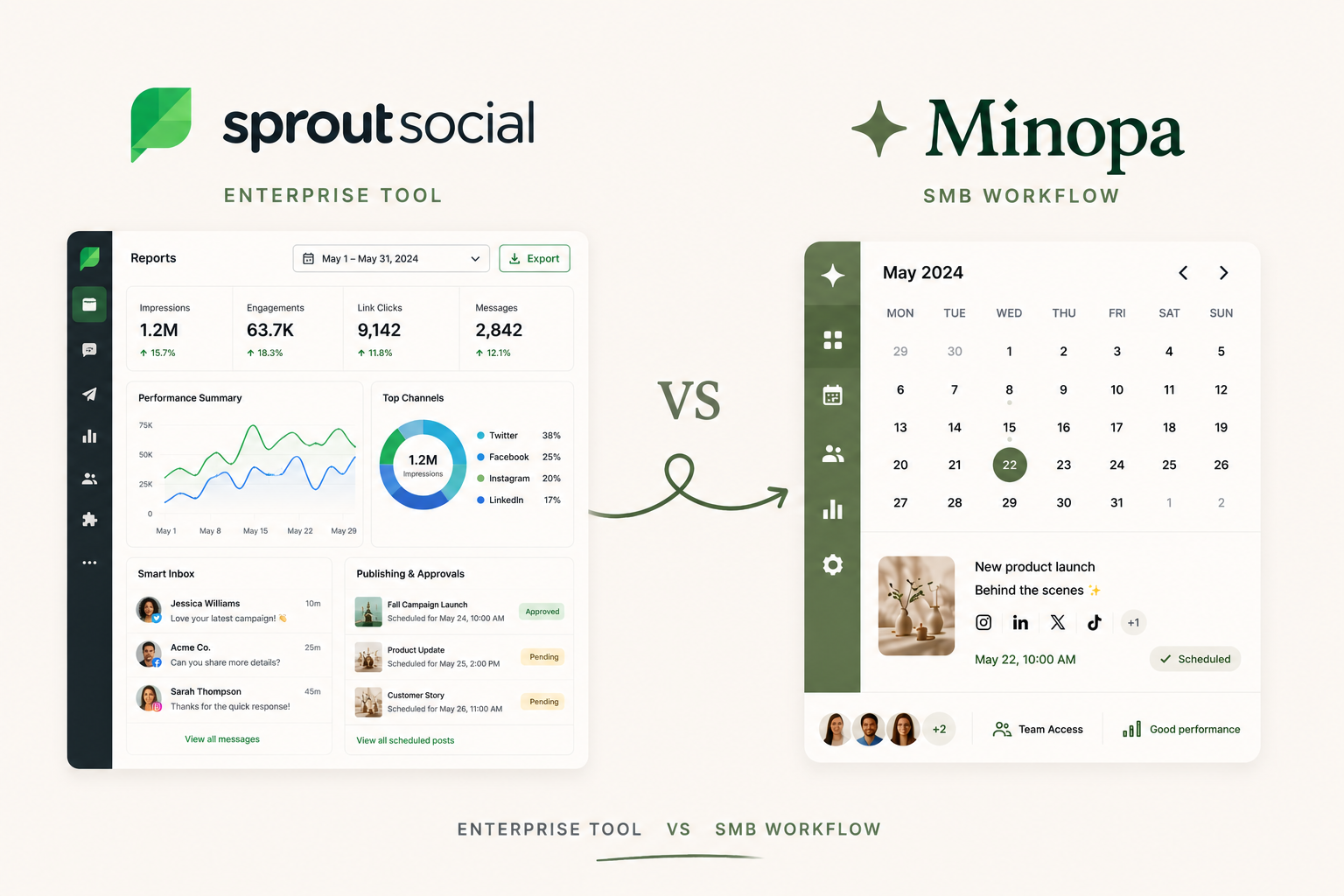
Sprout Social vs Minopa: Enterprise Tool, SMB Workflow?
The short version of Sprout Social vs Minopa. Sprout earns its premium for enterprise teams with deep listening, CRM hooks, and approval workflows. Minopa is the self-serve alternative for lean teams whose weekly job is publishing rather than monitoring.
At a glance: Sprout Social vs Minopa
| Sprout Social | Minopa | |
|---|---|---|
| Free tier | None (free trial only) | Yes (Free plan: 1 account, 15 posts/month) |
| Paid entry plan | Standard (per seat) | Creator |
| Pricing structure | Per seat, multi-seat scaling on higher tiers | Flat per-plan, workspaces included |
| Onboarding | Sales-led (demo + contract) | Self-serve from Free |
| Integrations | 30+, deep CRM and Salesforce hooks | 9 native (IG, FB, X, LinkedIn, TikTok, Threads, Pinterest, Canva, Google Drive) |
| Workspaces / multi-brand | Higher tiers | Free includes 1, multi-workspace on Creator and above |
| Social listening | Yes (Premium tier) | Not currently shipped |
| Approval workflows | Yes (Professional and above) | Not currently shipped |
| Salesforce + Microsoft integration | Yes | No (out of scope) |
| UI languages | English-heavy, partial | English, German, Spanish, French, Turkish |
| Best for | Mid-market and enterprise with listening + CRM | Freelancers, solo creators, lean in-house teams |
Sprout's pricing and Minopa's pricing hold the live numbers. The per-seat structure on one side and flat-plan structure on the other is what compounds the cost gap.
Sprout Social, in two paragraphs
Sprout Social is the premium category answer for mid-market and enterprise teams. The listening tools surface brand mentions, sentiment, and competitor activity at scale. The Smart Inbox unifies engagement across networks. Salesforce and Microsoft Dynamics integrations close the loop between social activity and the CRM. Approval workflows route every post through legal or brand sign-off, and audit trails satisfy security review. For a fifteen-person social team at a publicly traded company, every line item earns its keep.
Where Sprout falls short for smaller teams is the price-and-process shape. Onboarding runs through a sales demo and an annual contract; there is no self-serve checkout flow. Per-seat pricing on the Standard tier starts around $199, and Professional climbs higher with multi-seat scaling on top. A two-person agency or solo creator running their own brand pays for a listening engine, a CRM bridge, and approval workflows they never actually trigger. The right tool for the wrong size is still the wrong tool.
Where Minopa fits
Minopa is the self-serve alternative for everything Sprout was not built to serve. The Free plan lets you connect one account and ship fifteen posts a month with no card. The Creator plan opens all nine integrations (Instagram, Facebook, X, LinkedIn, TikTok, Threads, Pinterest, plus Canva and Google Drive imports). The Growth and Scale tiers add workspaces and team seats for freelancers and lean in-house teams. There is no demo, no contract, no quarterly business review baked into the price.
Three situations point to Minopa. You're a freelancer or solo creator running 1 to 5 brand workspaces. Your weekly job is publishing, not social listening or competitor monitoring. Or your team is small enough that approval workflows would slow you down, not protect you. Where Sprout Social still wins: if your team needs social listening, Salesforce integration, audit logs, or approval workflows that route a post through legal sign-off, Sprout Social is the tool built for that work, and we don't pretend otherwise.
Per-seat math, in plain numbers
Per-seat pricing is the dominant cost driver in any Sprout vs flat-plan comparison. Sprout's Standard tier billing scales with the seat count. A four-person social team on Standard pays four times the base. Adding a contractor for a quarter doubles down on the seat math. The Professional tier raises the floor.
Minopa's paid plans don't bill per seat in the same way. A freelancer on Creator or a small team on Growth pays the plan rate once. Adding the second helper, or the third, lands inside the plan's seat allocation rather than tripling the bill. For lean teams who don't need a CRM bridge, the spread is structural.
What Sprout does that Minopa doesn't claim
Honesty over hype matters in the Sprout-vs-Minopa comparison because the feature gaps are real and they should be on the page. Sprout has deep social listening with sentiment, share-of-voice, and competitor benchmarking. Minopa doesn't ship social listening. Sprout has approval workflows that route posts through sign-off. Minopa doesn't currently ship approval workflows. Sprout has Salesforce and Microsoft Dynamics integrations; Minopa doesn't.
If those features are dealbreakers, the comparison ends there. Sprout is the right tool. Pretending otherwise wastes your evaluation cycle.
Self-serve vs sales-led onboarding
Sprout's go-to-market runs through a demo and an annual contract. That is a reasonable fit for enterprise procurement teams who already buy software that way. It's a friction point for a freelancer or a four-person startup who wants to try a tool on a Tuesday afternoon.
Minopa is self-serve from the Free plan up through Scale. You sign up, you connect an account, you schedule a post. If the workflow fits, you upgrade. If it doesn't, you cancel. That motion is the wrong fit for compliance-heavy enterprise; it's the right fit for everyone else.
Who should pick which
If your team needs social listening, Salesforce integration, approval workflows, or audit logs at enterprise scale, Sprout Social is the right tool. The price reflects the surface area you actually need.
If your team is one to ten people, your weekly job is publishing across seven or fewer platforms, and you'd rather sign up than schedule a demo, Minopa is the better long-term home. Run the seat math on Sprout's pricing and the plan math on Minopa's pricing with your actual head count and channel count in hand. The two structures rarely look close once the numbers are on the page.
Frequently asked questions
Is Minopa cheaper than Sprout Social?
Usually, for lean teams. Sprout bills per seat, so a four-person team pays four times the base and a contractor adds another seat on top. Minopa's paid plans charge a flat per-plan rate, with additional helpers landing inside the plan's seat allocation rather than tripling the bill. Run the seat math on Sprout's pricing against the plan math on Minopa's pricing, since both move over time.
Is Minopa a good Sprout Social alternative for small teams?
For most freelancers, solo creators, and lean in-house teams, yes. Minopa is self-serve from the Free plan up, with no demo or contract, and its flat per-plan structure avoids the per-seat scaling that makes Sprout expensive at small head counts. The trade is that Sprout's enterprise surface area, listening, CRM hooks, and approval workflows, isn't part of Minopa.
Does Minopa have listening or CRM features like Sprout?
No. Minopa doesn't ship social listening, and there are no Salesforce or Microsoft Dynamics integrations. Sprout's listening surfaces sentiment, share-of-voice, and competitor benchmarking, and its CRM hooks close the loop between social activity and the customer record. If those are dealbreakers, Sprout Social is the right tool.
Can I self-serve sign up for Minopa instead of booking a Sprout demo?
Yes. Sprout's go-to-market runs through a sales demo and an annual contract. Minopa is self-serve from the Free plan: you sign up, connect an account, and schedule a post without talking to anyone. If the workflow fits you upgrade, and if it doesn't you cancel.
When enterprise doesn't fit, start where there's no demo call
If the Sprout decision came down to paying per seat for a listening-and-CRM engine you won't trigger, Minopa's Free plan lets you try flat-rate, self-serve publishing today with no card and no demo call. Compare the plans against your real head count and channel count before you commit to per-seat billing.