
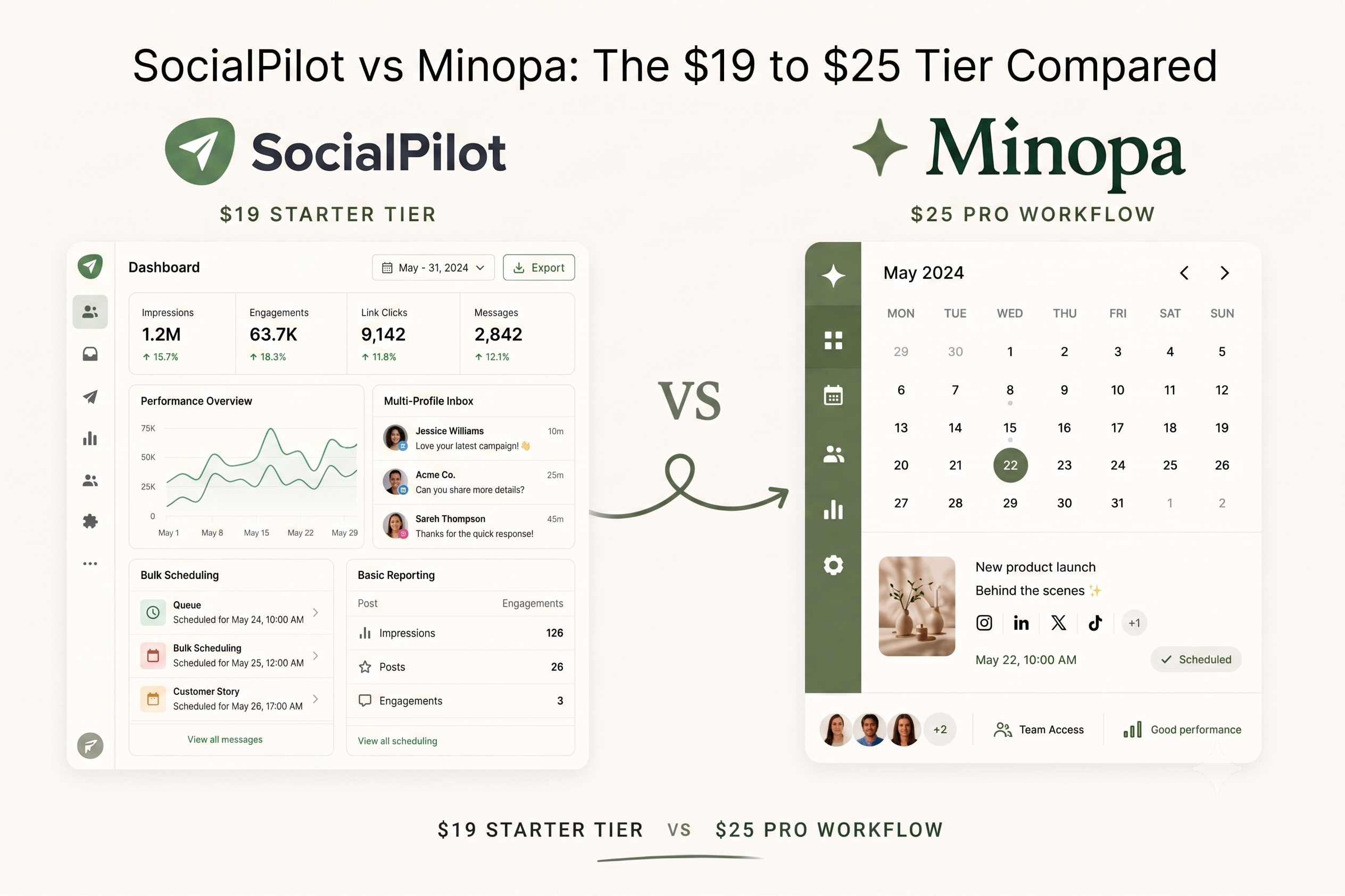
SocialPilot vs Minopa: The $19 to $25 Tier Compared
The short version of SocialPilot vs Minopa. SocialPilot wins for agencies whose top need is white-label reporting and bulk-scheduling many accounts. Minopa wins for creators and small agencies whose top need is Canva-native publishing across nine integrations with cleaner workspace permissions.
At a glance: SocialPilot vs Minopa
| SocialPilot | Minopa | |
|---|---|---|
| Free tier | No (free trial only) | Yes (Free plan: 1 account, 15 posts/month) |
| Paid entry plan | Professional | Creator |
| Pricing structure | Per plan with account caps | Flat per-plan with workspaces included |
| Integrations | IG, FB, X, LinkedIn, TikTok, Pinterest, YouTube, Google Business, Tumblr | 9 native: IG, FB, X, LinkedIn, TikTok, Threads, Pinterest, plus Canva + Google Drive |
| Bulk scheduling | Yes (CSV upload, bulk operations) | Available via media library workflows |
| White-label reports | Yes (agency tiers) | Not currently shipped |
| Multiple workspaces | Yes (account caps per plan) | One on Free, multiple on Creator and above |
| Canva native import | Limited | Yes, into the media library |
| Google Drive import | Limited | Yes, native |
| Threads support | Limited | Native |
| UI languages | English-heavy | English, German, Spanish, French, Turkish |
| Best for | Agencies needing white-label + bulk scheduling | Creators and agencies needing Canva-native publishing |
SocialPilot's pricing and Minopa's pricing hold the live numbers. Both tools land in the same entry-tier price band; the structural difference is which features they prioritize on the entry plan.
SocialPilot, in two paragraphs
SocialPilot built its identity around agency-friendly workflows at a budget price point. The entry tier supports more connected accounts than most competitors at the same price, bulk scheduling is a first-class feature with CSV upload built for power users, and white-label reports on higher tiers let agencies brand their client deliverables. The integration list is broad and includes some niche platforms (Tumblr, Google Business) that other tools skip. For a small agency whose weekly job includes preparing branded performance reports for five client retainers, that surface is the reason to pick the tool.
Where SocialPilot falls short for creators and small agencies on a Canva-heavy workflow is the design-import experience. The Canva integration is light, Google Drive support is limited, and Threads support has been slower to mature than the broader category. The interface skews toward feature density rather than approachability, which is fine for power users and rough for first-time setup. The English-heavy UI doesn't ship with the full five-language localization at the entry tier.
Where Minopa fits
Minopa lands in the same entry-tier price band as SocialPilot but prioritizes different features on the entry plan. The Creator plan covers all nine integrations natively (Instagram, Facebook, X, LinkedIn, TikTok, Threads, Pinterest, plus Canva and Google Drive imports). Workspaces on Creator and above let freelancers and small agencies isolate clients with admin, member, and viewer roles. The composer is multi-platform from the start with per-platform caption tweaks built in. The five-language UI (English, German, Spanish, French, Turkish) ships at the same price as the English-only experience.
Three situations point toward Minopa. Your weekly workflow includes importing designs from Canva or Google Drive often enough that native integration saves real time. You manage three or four brand workspaces and want clean admin/member/viewer roles without paying for agency-tier features you won't use. Or your clients work in non-English languages and the localized UI matters for collaboration. Where SocialPilot still wins: if your agency model depends on delivering white-label PDF reports to clients on a monthly cadence, SocialPilot ships that feature today and Minopa doesn't.
Where each tool wins on the entry plan
The honest framing of SocialPilot vs Minopa is what each tool gives you on the entry plan. SocialPilot's entry tier prioritizes account count and bulk scheduling. Minopa's entry tier prioritizes integration depth (Canva, Google Drive, Threads) and workspace permissions.
For a small agency whose weekly engine is bulk-scheduling pre-built content across many client accounts, SocialPilot's entry tier is the right shape. For a creator or small agency whose weekly engine is designed content moving from Canva to a multi-platform composer, Minopa's entry tier is the right shape. Both cost roughly the same; what they buy you is different.
Workspaces and agency permissions
A small agency running multiple clients needs workspaces with permission controls, not just an account count. SocialPilot supports multiple client accounts per plan but the permission model is lighter than agency owners often need.
Minopa includes one workspace on Free, unlocks multiple workspaces on Creator, and adds granular admin/member/viewer roles on Growth and above. An agency owner can grant a client's marketing coordinator drafting rights without giving them the ability to disconnect a social account. For agencies, that role-level control is the structural feature.
Canva, Google Drive, and the design-import gap
SocialPilot's Canva integration exists but feels light, and Google Drive support is limited. Designs still tend to move through manual upload or third-party bridges.
Minopa imports designs directly from Canva and Google Drive into the media library, with cropping and resizing inside the app. For a Canva-heavy weekly workflow, that single integration removes the largest manual step.
Who should pick which
If your agency model depends on white-label reporting, bulk-scheduling many accounts, and a feature-dense interface your team is comfortable navigating, SocialPilot is the right tool at the entry tier price band.
If your weekly engine is Canva-imported content moving across nine platforms, you want cleaner workspace permissions, or your clients are non-English speakers, Minopa is the better long-term home. Compare both at your actual platform and workspace count on SocialPilot's pricing and Minopa's pricing; the decision usually answers itself once your weekly content shape is on the page.
Frequently asked questions
Is Minopa or SocialPilot cheaper?
Both land in the same entry-tier price band, so the headline number rarely decides it. Minopa's flat per-plan pricing folds multiple workspaces and all nine integrations into one tier; SocialPilot's entry tier prioritizes connected account count and bulk scheduling. Run your real platform and workspace count against SocialPilot's pricing and Minopa's pricing, since both move over time.
Is Minopa a good SocialPilot alternative?
For creators and small agencies whose weekly engine is Canva-imported content moving across nine platforms, yes. Minopa's Creator plan covers all nine integrations natively, including native Threads and Google Drive imports that SocialPilot treats as limited. If your top need is white-label reporting or bulk-scheduling many accounts, SocialPilot stays the stronger fit.
Does Minopa have agency and client features like SocialPilot?
Partly. Minopa unlocks multiple workspaces on Creator and above, with granular admin, member, and viewer roles so you can isolate clients. What it doesn't ship is white-label PDF reporting, which SocialPilot offers on its agency tiers. If branded client reports are load-bearing, SocialPilot is the better pick.
Can I import Canva designs into Minopa?
Yes, natively. SocialPilot's Canva integration exists but feels light, and Google Drive support is limited. Minopa imports from both directly into the media library, with cropping and resizing in-app and no third-party bridge.
Start free at the same entry price
Minopa's Free plan lets you try Canva-native, multi-platform publishing without a card, before you weigh it against SocialPilot at the same entry-tier price band. When your weekly engine is designed content moving across nine platforms, the flat-rate Creator plan keeps every integration under one price. Compare the plans against your actual platform and workspace count.