
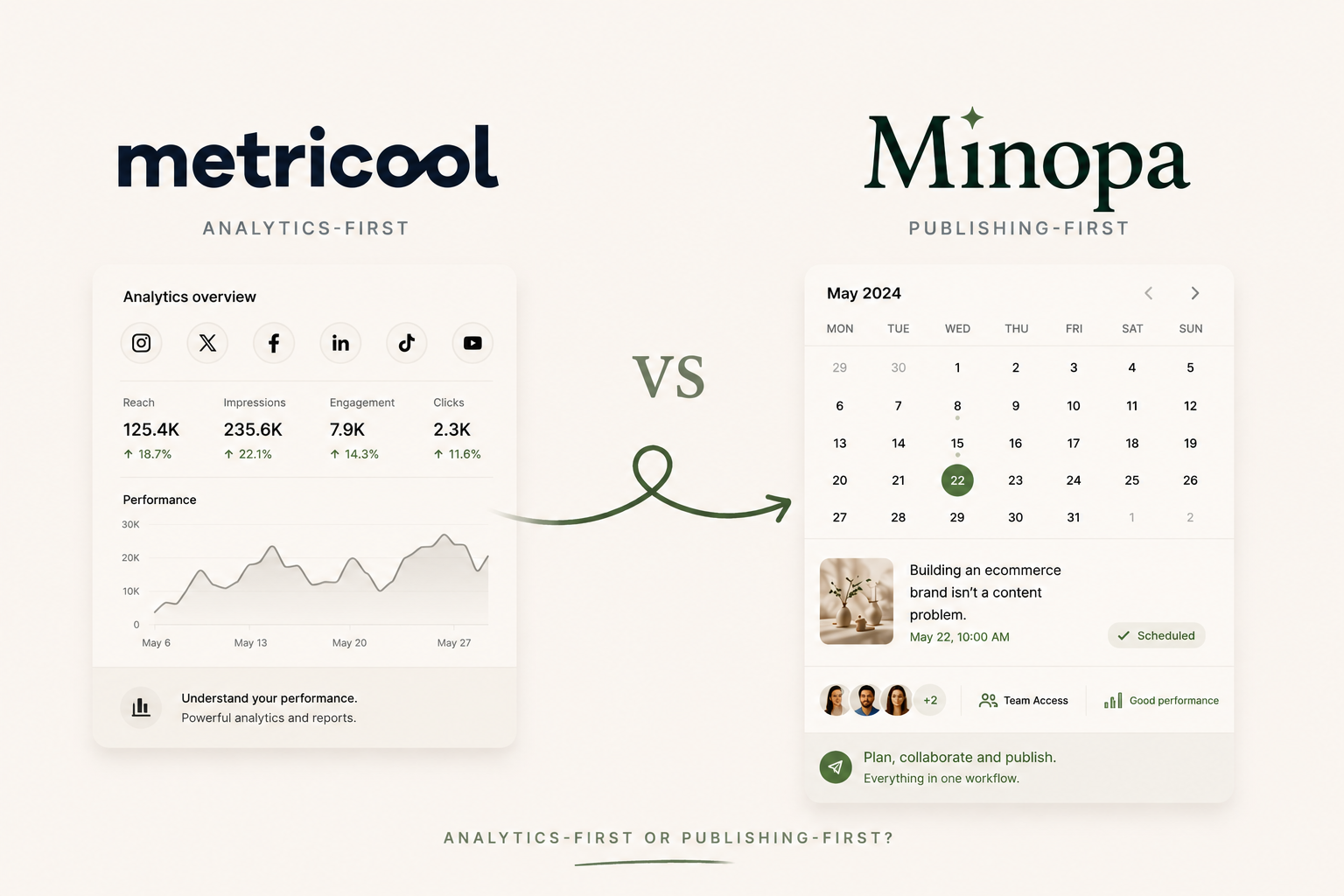
Metricool vs Minopa: Analytics-First or Publishing-First?
The short version of Metricool vs Minopa. Metricool wins when analytics depth is what drives your weekly decisions. Minopa wins when publishing speed, workspaces, and design imports are what drive your weekly decisions.
At a glance: Metricool vs Minopa
| Metricool | Minopa | |
|---|---|---|
| Free tier | Yes (1 brand, 50 scheduled posts/month) | Yes (Free plan: 1 account, 15 posts/month) |
| Paid entry plan | Starter | Creator |
| Pricing structure | Per brand on paid plans | Flat per-plan, workspaces included |
| Integrations | IG, FB, X, LinkedIn, TikTok, Pinterest, YouTube, plus Google My Business, Twitch | 9 native: IG, FB, X, LinkedIn, TikTok, Threads, Pinterest, plus Canva + Google Drive |
| Analytics depth | Deep (best-time-to-post, competitor benchmarks) | Not currently shipped |
| Workspaces / multi-brand | Per-brand pricing on paid plans | One on Free, multiple on Creator and above |
| Canva native import | Limited | Yes, into the media library |
| Google Drive import | No | Yes, native |
| UI languages | Spanish-first, English second, plus others | English, German, Spanish, French, Turkish |
| Best for | Creators picking by analytics | Creators picking by publishing + design workflow |
Metricool's pricing page and Minopa's pricing hold the live dollar amounts. The structural split (per-brand vs flat-plan) is what compounds the bill once you cross the free tier.
Metricool, in two paragraphs
Metricool's identity is analytics-first scheduling. The free tier is one of the most generous in the category (one brand, fifty scheduled posts a month), and the analytics layer is the reason creators stay. Best-time-to-post recommendations are baked in. Competitor benchmarking sits next to your own performance charts. Hashtag analysis pulls real engagement data rather than guessing. For a creator who treats every Sunday as a data-driven planning session, that surface earns its place.
Where Metricool falls short for multi-platform creators with a design-heavy workflow is the publishing experience. Per-brand pricing on paid plans punishes adding a second brand workspace, and the upgrade path from "one brand free" to "one brand plus a side project" feels steep. Canva integration is light. Google Drive isn't native. The Spanish-first heritage shows in the UI; the English translation is workable but occasionally rough. Threads support has been slow compared to the broader category.
Where Minopa fits
Minopa's identity is publishing-first scheduling. The Creator plan covers all nine integrations natively (Instagram, Facebook, X, LinkedIn, TikTok, Threads, Pinterest, plus Canva and Google Drive imports). The composer is multi-platform from the start, with per-platform caption tweaks built in. Workspaces on Creator and above let freelancers and small agencies isolate clients without paying a per-brand surcharge. The five-language UI (English, German, Spanish, French, Turkish) ships at the same price as the English-only experience.
Three patterns point toward Minopa. You schedule to four or more platforms and want one composer that respects each platform's fold. You import from Canva often enough that the manual export step wastes your week. Or you run multiple brand workspaces and don't want the per-brand pricing penalty. Where Metricool still wins: if your weekly planning depends on best-time-to-post recommendations, competitor benchmarking, or deep hashtag analytics, Metricool is the tool built for that work. Minopa doesn't currently ship those analytics features.
Analytics vs publishing, in plain terms
The honest framing of Metricool vs Minopa is what drives your week. If your weekly ritual is opening the analytics dashboard, reading the numbers, and adjusting the next week's plan, Metricool's depth is the reason you stay there. The free tier alone covers most of what a solo creator needs to make informed decisions.
If your weekly ritual is composing posts across multiple platforms, importing from Canva, and dragging slots across a calendar, Minopa's publishing flow is the reason you stay there. The analytics layer is genuinely lighter; that's the trade. Picking the wrong axis for your output is the common reason creators churn tools every six months.
Workspaces and per-brand math
A freelancer running two or three brands hits the per-brand pricing pattern on Metricool's paid plans quickly. Each additional brand adds to the bill before any seat math.
Minopa includes one workspace on Free and unlocks multiple workspaces on Creator and above without a per-brand surcharge. A freelancer with three brand workspaces on Growth pays the plan rate once, not three times. For multi-brand work, that structural difference shows up as a meaningful annual spread.
Canva, Google Drive, and the design-import gap
Metricool's Canva integration exists but is light; designs still tend to move through manual upload steps. Google Drive isn't a native source.
Minopa imports designs directly from Canva and Google Drive into the media library, with cropping and resizing inside the app. The composer pulls from that library when you schedule. For creators producing twenty or thirty designed posts a month in Canva, that single integration removes the largest manual step in the workflow.
Who should pick which
If your weekly decisions are driven by analytics and the best-time-to-post recommendation engine, Metricool is the right tool. The free tier covers most of what solo creators actually use, and the analytics depth is the reason to upgrade.
If your weekly decisions are driven by publishing speed across four or more platforms, design imports from Canva, and workspaces per brand or client, Minopa is the better long-term home. Run your own week against Metricool's plans and Minopa's pricing; the right tool depends on which axis (analytics or publishing) actually moves your output.
Frequently asked questions
Does Minopa have analytics like Metricool?
Not currently. Metricool's analytics layer is its load-bearing feature: best-time-to-post recommendations, competitor benchmarking, and engagement-based hashtag analysis. Minopa doesn't ship those analytics today, so if data drives your weekly planning, Metricool stays the better fit.
Is Metricool or Minopa better for scheduling?
It depends on what you publish. Minopa is publishing-first, with a multi-platform composer, per-platform caption tweaks, and native Canva and Google Drive imports across nine integrations. Metricool schedules well too, but its strength sits in the analytics layer rather than the publishing flow. For a multi-platform, design-heavy week, Minopa's composer is the faster surface.
Is Minopa cheaper than Metricool?
It depends on brand count. Metricool prices per brand on paid plans, so a second brand workspace adds to the bill. Minopa's flat per-plan pricing folds multiple workspaces into one tier with no per-brand surcharge, so a freelancer running three brands on Growth pays the plan rate once. Check Metricool's pricing page and Minopa's pricing against your own brand count.
Can I import Canva designs into Minopa?
Yes, natively. Metricool's Canva integration exists but is light, and Google Drive isn't a native source. Minopa imports from both directly into the media library, with cropping and resizing in-app and no manual export step.
Pick the axis that moves your week
Minopa's Free plan lets you try publishing-first scheduling on one account before committing, with no card. If the analytics-first versus publishing-first decision lands on publishing for you, compare the plans against your brand and platform count to see where the flat-rate tiers fit.